
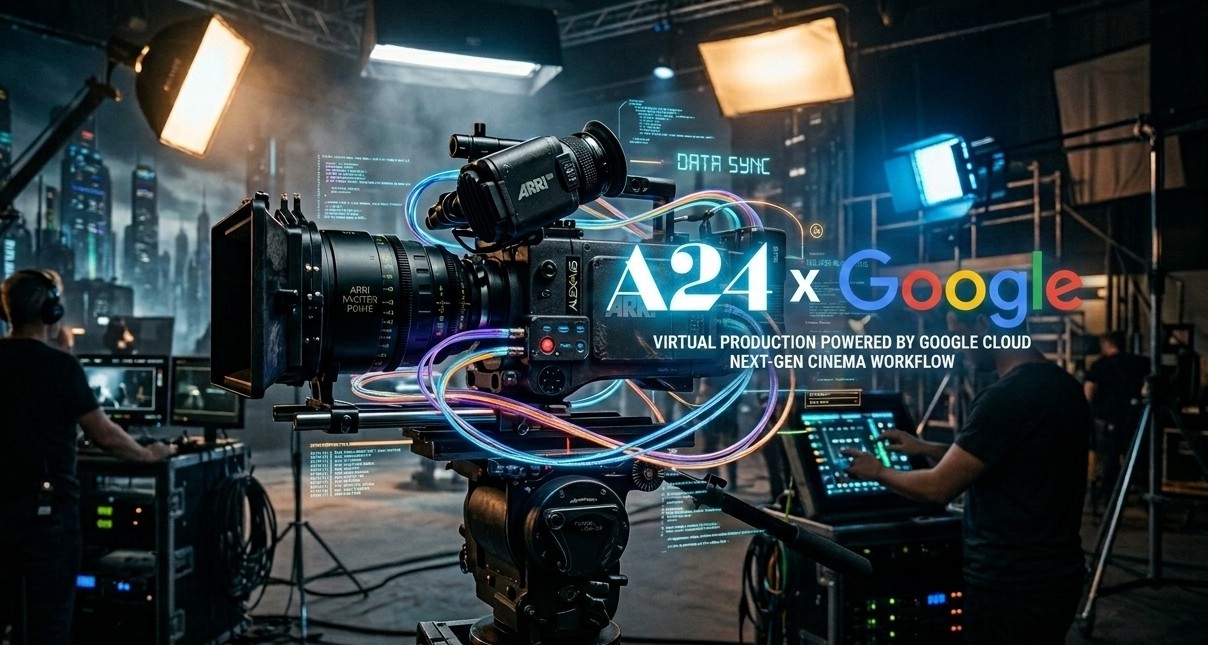
If you’ve spent any time on A24’s social media this week, you’ve seen the meltdown.
The studio that built its identity on being the anti-Hollywood—the home of Everything Everywhere All At Once, Moonlight, and this year’s surprise smash Backrooms—just took $75 million from Google and partnered with its DeepMind AI division. Fans are furious. Filmmakers are nervous. And A24 is spending the week explaining itself.
So what’s actually happening here, and should A24 diehards be as worried as the subreddit suggests?
The Purpose: A Seat at the Table, Not a Hostile Takeover
Announced this week, the deal is a multi-year, non-exclusive research partnership between A24 and Google DeepMind.
In practice, DeepMind researchers will work directly alongside A24’s filmmakers and its in-house tech division, A24 Labs, to study how the studio actually makes movies—its workflows, production processes, and how it identifies talent—to build new AI-assisted tools.
Crucial Guardrails to Know:
- No Library Access: Google does not get access to A24’s film library or proprietary data. They won’t be training models on Hereditary or Lady Bird.
- Buying Insight, Not Content: What Google is buying isn’t the films themselves, but the thinking behind them: how a scrappy indie studio with tight budgets consistently produces critical and box office hits.
“We would rather have a seat at the table than on the sidelines.”
— Sophia Shin, A24 Communications Head
The studio’s logic is simple: AI tools for filmmaking are coming whether A24 participates or not. They would rather help shape what those tools look like than have Silicon Valley hand tech down to filmmakers without their input.
The Benefits: Why This Makes Sense for A24
It’s easy to read this purely as a cash grab, but there’s a real strategic logic underneath the controversy:
- Funding Without Losing Independence: The $75 million investment is in line with what A24 raised from Thrive Capital in its last funding round. This isn’t a desperate bailout; it’s a continuation of how the studio finances itself, with no mandate forcing filmmakers to use the resulting tools.
- Influence Over the Tools: A24 Labs head Scott Belsky clarified that the goal isn’t generative, prompt-based AI (the kind that spits out finished video from text). Instead, it’s aimed at behind-the-scenes production tools like AI-assisted storyboarding—a process Martin Scorsese has already publicly endorsed.
- A Proven Track Record: A24 has already quietly utilized AI. The Brutalist used AI technology to refine Adrien Brody’s Hungarian-language dialogue during awards season. This deal simply formalizes an approach they were already experimenting with.
- Access to Serious Infrastructure: DeepMind is behind Google’s Veo video model. For an indie studio that punches above its budget, having that kind of research muscle available—without building it in-house—is a massive resource.
The Pushback: Why Fans Aren’t Buying It
None of that context has stopped the backlash. A24’s Instagram and X posts have been flooded with comments accusing the studio of selling out. However, the most cutting criticism has come from inside the filmmaking community itself.
Key Voices of Dissent:
- Kane Parsons (Director of Backrooms): The 21-year-old director behind A24’s biggest theatrical hit ever ($330M on a $10M budget) has called AI “genuinely harmful,” stating it offers him “no enjoyment” creatively.
- The Directors of Heretic: Explicitly included a “no generative AI was used” disclaimer in their film’s credits.
The Broader Hollywood Trend
A24 is now part of a rapid, highly contentious industry pattern:
- Disney’s brief deal with OpenAI.
- Lionsgate’s expanded partnership with Runway.
- Netflix’s acquisition of Ben Affleck’s AI startup, InterPositive.
What the Future Looks Like for A24
This is where things get genuinely uncertain. A24’s entire brand is built on being a place where filmmaker vision comes first and risky projects get made because the math doesn’t have to look like a major studio’s spreadsheet.
| The Best-Case Scenario | The Worst-Case Scenario |
| Tools speed up tedious pre-production, assist with storyboarding, and solve workflow bottlenecks. | Filmmaker control gets gradually negotiated away in the name of corporate efficiency. |
| A24 keeps backing distinctive voices with fewer resource constraints. | The studio faces permanent PR scrutiny, with audiences demanding “No AI” disclaimers on every release. |
The Flexibility Clause
Fortunately, the deal is non-exclusive. A24 isn’t locked into Google’s ecosystem, and DeepMind isn’t locked into A24 (DeepMind already collaborates with individual filmmakers like Darren Aronofsky). This gives A24 the room to walk back or recalibrate the relationship if the tools don’t actually serve the creative process.
The real test won’t be this week’s headlines. It will be the next two or three years of A24 releases, and whether audiences can tell the difference—or if the studio’s reputation for immaculate taste can survive contact with its newest, most powerful partner.


Leave a Reply